
Monit Data scores high in EIT Urban Mobility RAPTOR proposal for the City of Edinburgh
Recently Monit Data participated in an EIT Urban Mobility RAPTOR proposal for the City of Edinburgh. RAPTOR is an innovative programmes that matches urban mobility challenges with solution providers. The challenge for the City of Edinburgh was to increase the quality of the urban environment by reducing heavy traffic. The proposal was looking for the application of data-driven parking management to meet this challenge.
This proposed solution demonstrates the ever-growing importance of data in urban mobility and parking policies. Often public or political pressure can influence these policies, or they can lean too much on experience and perceptions. Whereas data provides a clear objective picture, and how changes in policies affect these. But with a scattered landscape of parking systems, data formats, getting this data has proven to bring its own challenges.
This is a challenge Monit Data has taken on. For over 15 years we have been transforming raw unorganised data into clear actionable insights using our unique Parking Monitor platform. We therefore included our solution into the RAPTOR proposal to share our experience and knowledge with the City of Edinburgh.
The RAPTOR programme
The Rapid Applications for Transport (RAPTOR) programme matches urban mobility challenges in Europe with industry solutions. These solution providers can be start-ups or established small to medium enterprises (SME). The goal of the programme is city-driven, challenge-based, and agile innovation. The benefit of this approach is that solutions can be fast-tracked in development or improvements, and quickly tested in a real-life environment. Thereby helping to drive the transition tot sustainable mobility and better urban environments in European cities.
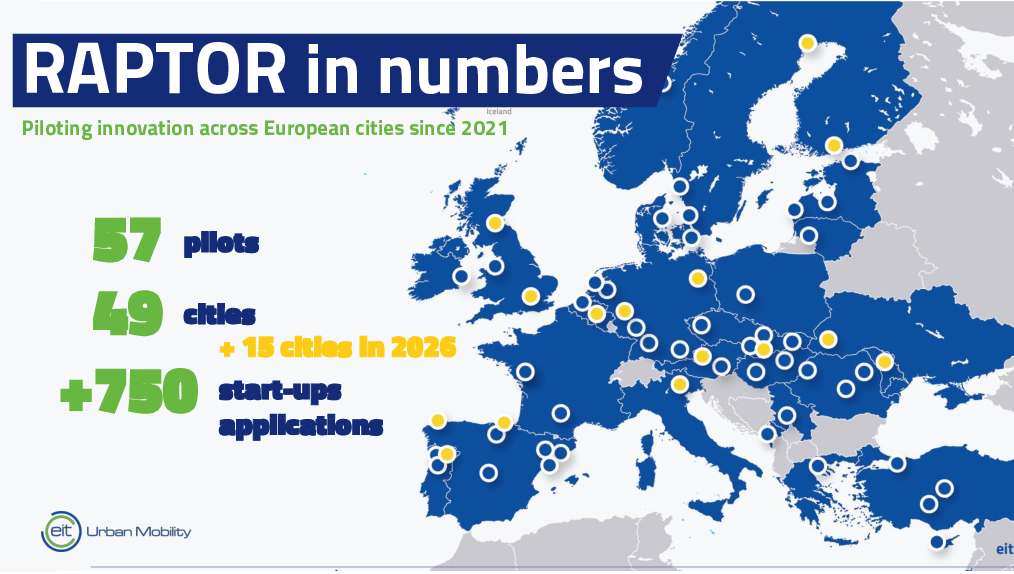
The RAPTOR programme is managed by EIT Urban Mobility. This was founded as an initiative of the European Institute of Innovation and Technology (EIT), a body of the European Union, EIT Urban Mobility is the largest innovation community for urban mobility in Europe, and is committed to accelerating the transition to sustainable mobility.
Edinburgh’s challenge
The challenge of the City of Edinburgh in the RAPTOR programme fits these goals of a better and greener Urban environment. The city is aiming to reduce the number of heavy and high-emission vehicles in the historic city center. The desired solution to meet these goals was data-driven parking management.

The solution with Monit Data’s Parking Monitor
Monit Data has the solution for data-driven parking parking management with our unique Parking Monitor platform. The dense urban environment of the Netherlands has accelerated the need for effective parking management. To help cities and private parking operators with data-driven insights, Monit developed the Parking Monitor, now being used in over 40 cities and processing over 100 million parking transaction annually.
The Parking Monitor is a cloud based software suite that automatically collects and transforms parking data from mutiple sources into valuable insights. A single clear dashboard includes reports on all important mobilty information, such as on- and off-street parking, EV charging and more.
You no longer need to spend resources on tedious manual data collection, but can now focus on using Monit’s insights for data-driven decisions for your mobility policies, finances, and operations.
Meeting Edinburgh’s challenges
The challenge of the City of Edinburgh consisted of two core elements; firstly being able to determine how many heavy vehicles were actually parked in the city, and secondly setting up a pricing strategy to manage how many of these vehicles enter the city center.
Monit Data therefore proposed the use of three modules, of the many available, of the Parking Monitor solution.
Parking Occupancy
This is one of the key core modules of the Parking Monitor. It allows parking operators to measure parking occupancy both on- and off-street. These analytics can be presented per street, neighbourhood or off-street facility. And of course also per time interval you want. All in one easy to use dashboard. Data is automatically sourced from parking systems and barrier systems from all major suppliers. A relative new addition is the use of data generated by the scan car driving in city for enforcement purposes.
Vehicle type classification
This module, currently in the pilot phase, allows us to use license plate data to classify a vehicle. For example this can used to classify if a vehicle is an ICE or EV. For the City of Edinburgh data would be polled for information on weight, size, and emissions to create classification for ‘heavy’ vehicles. As data source DVLA data would be used. Monit is experienced in this area as we use data from the RDW (the Dutch equivalent of DVLA) for our services.
Pricing Scenarios
With vehicle classification and parking occupancy known, our third module gives the option to create a pricing strategy. The pricing module of the Parking Monitor allows simulation of different tariff structures, and the effect on occupancy rates and parking revenues.
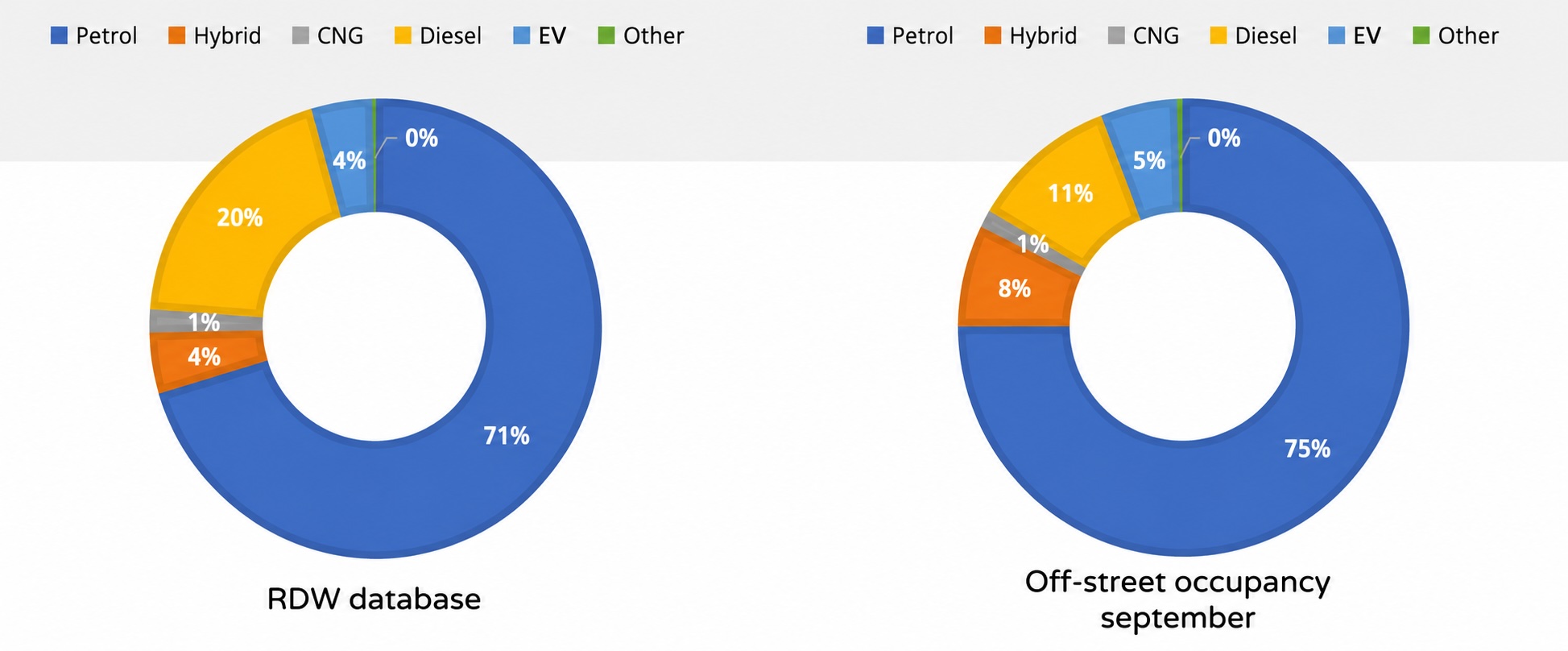
Example of vehicle classification by Monit for an off-street parking facility occupancy using RDW data.
Monit Data proposal received high scores
In the evaluation for the City of Edinburgh challenge Monit Data’s proposal received high scores from the RAPTOR programme. Although unfortunately our proposal was not selected for further funding and implementation, we look back at a very positive experience participating in this call for proposals.
First and foremost we are excited to see that parking data is seen as ever more important for creating better urban environments. Both in the RAPTOR programme and in European initiatives as Sustainable Urban Mobility Plans (SUMP).
Secondly we see that the choices of the Dutch parking sector to embrace data, and a centralised data infrastructure, at an early stage provides us with very valuable experience, knowledge, and solutions At Monit Data we are therefore looking forward to help our fellow European parking operators with better data-driven parking policies and operations.


